


 7:49:00 PM

Many people around the world take for granted the freedom to travel and freedom to work. Others have learned to take for granted that they are unable to do so. Thousands of refugees from Burma have lived confined to the camps in Thailand for 30 years. Although refugee camps are hardly natural places to live, thousands have been born in the camps and never left. For the vast majority of them, the only way of life they have ever known is one forced to be dependent on outside assistance. For many young refugees, refugee camps are where they were born and where they grew up, and the only reality they have ever seen exists within the fences of the camp.
“It is so strict to live here. There is nothing to do. I am not allowed to go outside the camp. There is no job, no work. So much stress and depression. I feel that I am going to go crazy here.” (Burmese refugee, Nu Po camp, Tak province, January 2012; Human Rights Watch, 2012e, p. 18)
Meanwhile, many older people have lived in the camps for so long that they can hardly remember their homeland anymore. This is all the while the refugee camps are only considered “temporary shelters” by Thai authorities who can close down the camps whenever they decide to do so. Thailand, in recent years, has made it no secret that they want to close the camps, causing growing concerns among the refugee population who do not feel safe to return.
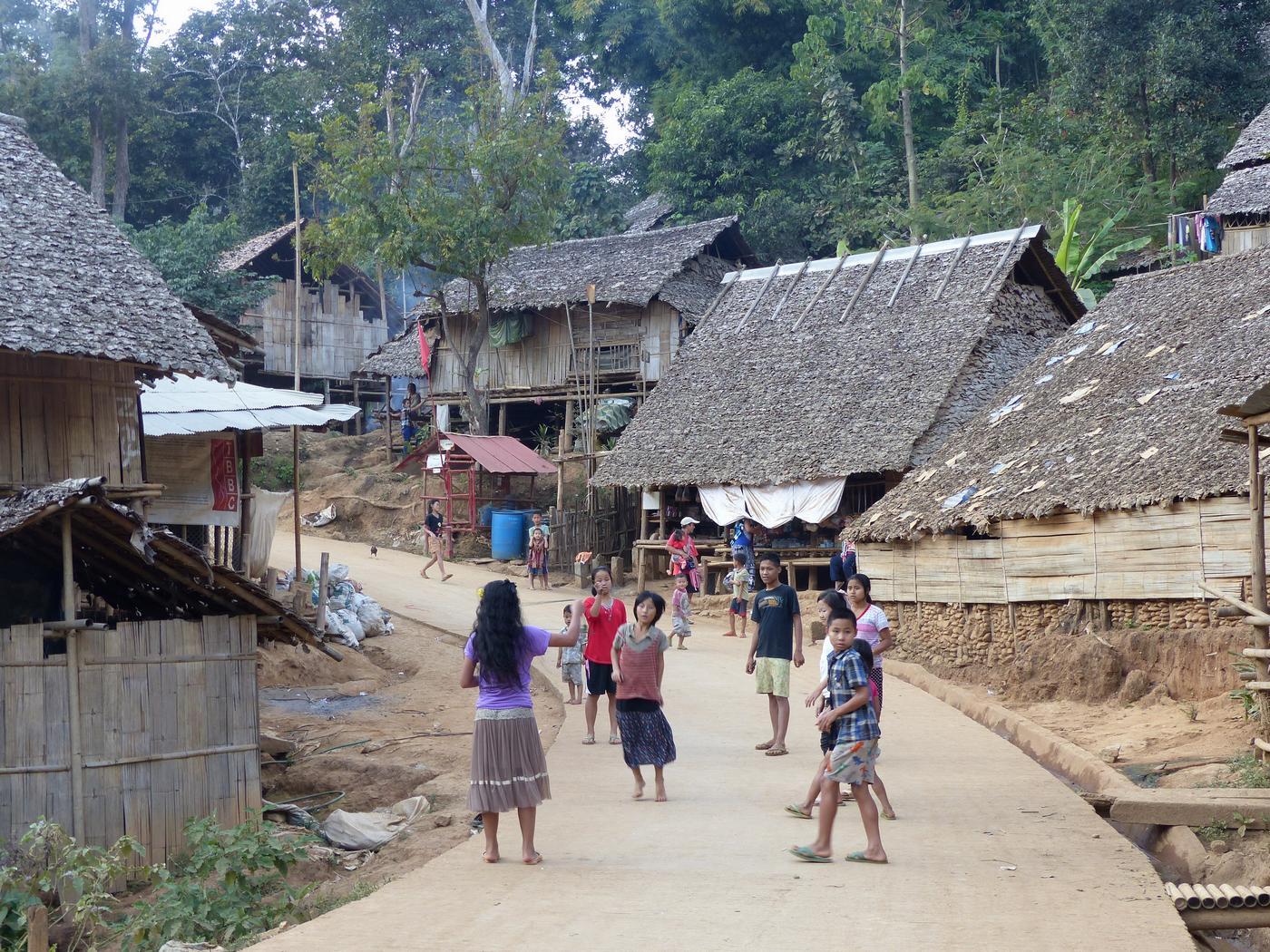
Children playing in Mae La Oon refugee camp, three hour drive from across the mountains from the town of Mae Sariang, Thailand. (Photo: Burma Link)
When the first refugees arrived in 1984, no one could have ever predicted that only would they still be there 30 years on. Majority of the refugees in the camps are Karen (79.1%) or Karenni (10.3%) from eastern Burma (TBC, December, 2014), who have fled armed conflicts and/or horrendous human rights abuse and persecution by the Burmese military. The government policy of Four Cuts, and what has been described as the slow genocide of ethnic peoples (La Guardia, June, 2005), resulted in the widespread destruction of communities and the decline of traditional cultures. Thousands of villages, especially in the Karen and Karenni States, were burned to the ground, including houses, religious buildings, schools, belongings, and sometimes even domestic animals. In many areas, it became the norm for the villagers to live in a constant fear of the Burmese military coming to their village, terrorising the villagers, stealing their food, forcing villagers to become porters and mine sweepers, raping ethnic women, and torturing and killing anyone suspected of having a connection the ethnic armed opposition. Whilst some villagers endured the abuse by developing warning systems and repeatedly fleeing to the jungle, others, who had heard about Thailand, decided to leave their village for good. Others still had no choice as their village was already in ashes on the ground.
Until 1995, refugees on the Thailand-Burma border lived in village-type settlements and were allowed to travel outside the camps to get food and shelter materials. Camp life changed dramatically in 1995 after the DKBA attacks; the village-type settlements were merged into large, sprawling camps that became increasingly dependent on outside aid as residents became more and more restricted on space and movement (TBC, 2004). Refugees still frequently break the rules of confinement and as a consequence, are often detained and occasionally deported (e.g. SHRF & SWAN, 2002). There are even reports of refugees been found killed outside the camp fences under mysterious circumstances (see e.g. Human Rights Watch, 2012e, pp. 37-38; Poe Kwa Lay, November 2012). Refugees have no means of seeking redress; similarly to Burmese authorities in their home country, Thai officials often seem to enjoy total impunity (see Human Rights Watch, 2012e).
Throughout the 1980s, 1990s, and 2000s, more refugees kept pouring across the border to Thailand. Alongside the growing need, a humanitarian and human rights network grew along the border. One of the organisations to respond to the crisis is The Border Consortium (TBC), which remains the main agency organising food and other aid to the refugees. TBC was originally formed by TBC’s former Executive Director Jack Dundorf who was among the first people to witness and respond to the urgent needs of thousands of refugees who fled to Thailand in 1984. TBC gradually evolved into a multi-membership aid organisation, and is one of the Executive Members of the Committee for Coordination of Services to Displaced Persons in Thailand (CCSDPT) that works together with the UNHCR to coordinate all humanitarian service and protection activities in Thailand.

Displaying American life to refugees in Mae La. (Photo: Liz Bordo)

Posters encouraging refugees to register their baby in Mae La camp. (Photo: Liz Bordo)
TBC maintains a database which includes all registered and unregistered refugees and is shared with the UNHCR to ensure compatibility. The database is updated monthly for births, deaths, departures, and new arrivals, to create the ‘verified caseload’. Food rations are distributed only to those who show up in person to receive their supplies. The actual number of people fed each month is known as the “feeding figure.” According to the December 2014 figures, the verified caseload in the camps was 110,607 and the feeding figure 108,583. As nearly 100,000 have been resettled to third countries, current numbers do not represent the overall population that has fled to the camps over the years.
In the camps, refugees have limited educational and training opportunities and no official means of earning an income. While education in the camps is far better than any education available to civilians inside Burma, there are limited opportunities for higher education, which also largely remains unrecognised outside the camps. Karen and other ethnic peoples of Burma traditionally place a very high value on education and many have crossed the border to Thailand in order to go to a camp school. Although the majority of the camp populations have arrived as a family unit (TBC, 2012b), many parents also send their children to attend schools in refugee camps across the Thai border (KHRG, 2008).